How real is the Bitcoin market?
10 November 2022
How real is the Bitcoin market?
There can be no doubting that Bitcoin’s price increase since it was created almost 15 years ago has been eye catching, with the world’s most famous cryptocurrency rising from less than USD $1 per coin in 2011, to more than USD $65,000 per coin at one point in late 2021.
Indeed, despite the huge pullback that we’ve seen in the last year, with the price crashing by roughly 70%, the returns from Bitcoin since it was launched will have dwarved most other assets, though this is in largely because it started with a tiny market value.
By that we mean that an asset that moves in value from $5 to $10 has generated a return of 100% (sounds amazing), but its only $5 of additional wealth created (barely enough for a cup of coffee these days), with Bitcoins miniscule size something we covered in a recent blog.
Despite the fact Bitcoin remains a tiny asset class, its increase since inception, and the life changing wealth it has created for the very tiny sliver of people who were both early buyers or miners of Bitcoin, and who held onto them for many years, are a key part of the marketing we see for Bitcoin and other cryptocurrencies to this day.
In essence, this marketing tries to convince investors that if they buy Bitcoin today, and hold on for years, they too will see their investment grow by many thousands of percentage points.
While there are many reasons we are sceptical of these claims (the law of diminishing returns being perhaps the most prominent), one thing we don’t think gets enough attention is the question marks that surround how the price increase of Bitcoin itself occurred.

Can you trust Bitcoin trading?
To explain our concern, imagine Bitcoin was a publicly listed stock, like CBA, or BHP, or Telstra.
Now imagine the CEO of Bitcoin was doing a talk to investors, explaining how amazing their company is, and pointed to the share price increasing from under $1 to more than $65,000, blowing away the performance of other stocks.
It’s only natural you’d be interested and might consider buying some yourself.
There are however at least three questions risk conscious investors might wish to ask that CEO about trading in the stock, and the price increase seen over the years.
We think the CEO would have difficulty answering them, as we highlight below.
Question 1. Has the trading in Bitcoin taken place on regulated exchanges?
By and large no.
Unlike shares in blue chip Australian shares, which trade on the highly regulated ASX, Bitcoin, and indeed many of the better-known cryptocurrencies trade on a large number of exchanges.
Indeed, some estimates suggesting there are now almost 600 cryptocurrency exchanges operating globally, while Coinmarketcap.com highlights more than 300.
Many of these exchanges are either not regulated at all or are operating in an environment where regulation is evolving. Indeed, many are registered in jurisdictions known for their ‘light touch’ approach to regulation, with multiple horror stories about exchanges being hacked and/or outright stealing customer assets.
That’s warning sign number one!
Question 2. Has the trading in Bitcoin taken place with real currency?
By and large no.
Unlike shares listed on the ASX, or gold and silver purchased from ABC Bullion, which is paid for in Australian dollars transferred from an APRA regulated bank account, most Bitcoin trading has not taken place with real currency.
Instead, cryptocurrency markets mostly trade using what are known in the industry as stablecoins. These stablecoins, the most famous, and largest of which is Tether, are typically designed so they track the price of a well-known fiat currency like the US Dollar, but they are not dollars.
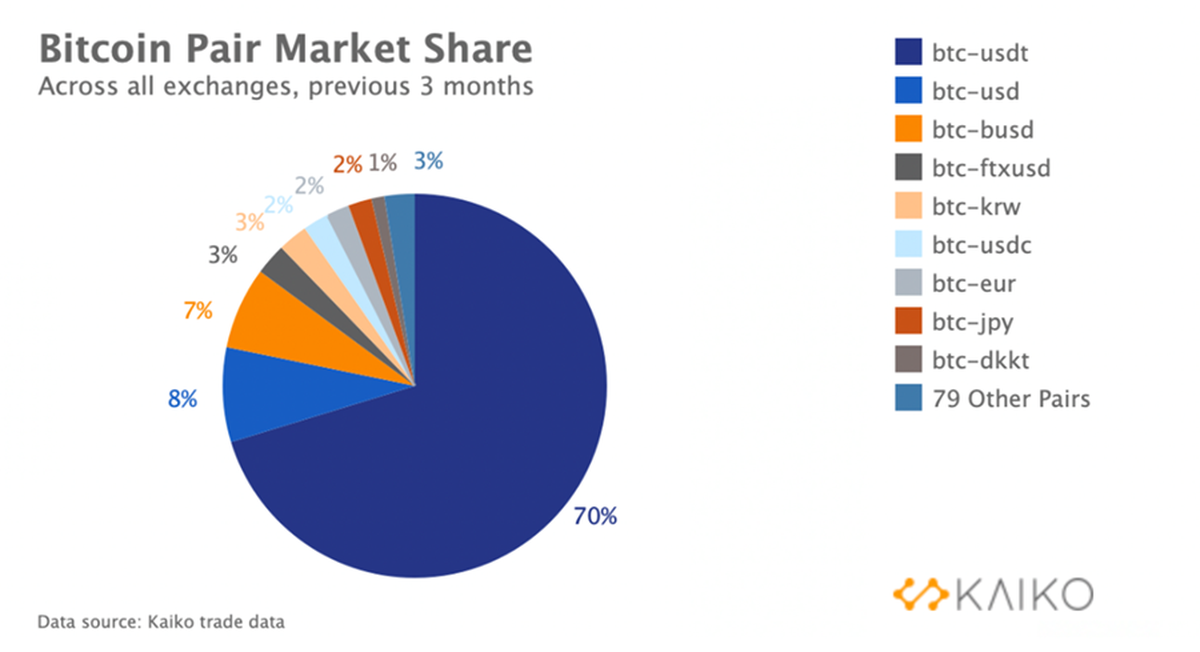
These stablecoins are critical to turnover in the cryptocurrency ecosystem, with estimates from a 2021 study suggesting “70 percent of bitcoin trading activity during the last three months was denominated in tether, with other stablecoins (primarily the dollar-denominated BUSD, FTXUSD and USDC) representing an additional 13 percent of overall bitcoin volumes.”
The dominance of stablecoins in Bitcoin trading is seen in the chart below.
The problem with these stablecoins is that they are sometimes
a. Not stable – as witnessed recently with the crash of TerraUSD
b. Not backed by the assets they claim to be
That’s warning sign number two!
Question 3. Are the trading volumes on the exchanges real?
By and large no.
Unlike the dollar value of trading we see on regulated stock exchanges, or on futures market exchanges, there is no real oversight measuring the validity of the trade volumes reported by cryptocurrency exchanges operating around the globe.
Indeed, a 2019 report from Bitwise Asset Management found that roughly 95% of reported Bitcoin trading volumes was fake, and that only 10 of 81 surveyed cryptocurrency exchanges provided volume figures that were legitimate.
That’s warning sign number three!
Conclusion
Yes, the price of Bitcoin did rise from less than USD $1 to at one point more than USD $65,000 per coin in late 2021.
But a not insignificant part of that price rise has been driven by what appears to be fraudulent trading taking place using stablecoins rather than real currency on unregulated exchanges that in certain instances have been complicit in perpetuating said fraud.
Note that none of this is actually the fault of Bitcoin per se. Indeed, one can admire the elegance and simplicity of the Bitcoin blockchain, which updates with more or less mathematical precision, and is designed so that in theory no more than 21 million coins will ever be issued.
Be that as it may, there can also be no doubting that the cryptocurrency ecosystem that has been built around Bitcoin, and which heavily influences the Bitcoin price, has more than a few question marks about it, which potential investors should be aware of.
The fact the price has now crashed by more than 70% suggests many investors are starting to realise these risks.
Warm regards,
The ABC Bullion Team
Disclaimer: This document has been prepared by Australian Bullion Company (NSW) Pty Limited (ABN 82 002 858 602) (ABC). The information contained in this document or internet related link (collectively, Document) is of a general nature and is provided for information purposes only. It is not intended to constitute advice, nor to influence any person in making a decision in relation to any precious metal or related product. To the extent that any advice is provided in this Document, it is general advice only and has been prepared without taking into account your objectives, financial situation or needs (your Personal Circumstances). Before acting on any such general advice, we recommend that you obtain professional advice and consider the appropriateness of the advice having regard to your Personal Circumstances. If the advice relates to the acquisition, or possible acquisition of any precious metal or related product, you should obtain independent professional advice before making any decision about whether to acquire it. Although the information and opinions contained in this document are based on sources we believe to be reliable, to the extent permitted by law, ABC and its associated entities do not warrant, represent or guarantee, expressly or impliedly, that the information contained in this document is accurate, complete, reliable or current. The information is subject to change without notice and we are under no obligation to update it. Past performance is not a reliable indicator of future performance. If you intend to rely on the information, you should independently verify and assess the accuracy and completeness and obtain professional advice regarding its suitability for your Personal Circumstances. To the extent possible, ABC, its associated entities, and any of its or their officers, employees and agents accepts no liability for any loss or damage relating to any use or reliance on the information in this document. It is intended for the use of ABC clients and may not be distributed or reproduced without consent. © Australian Bullion Company (NSW) Pty Limited 2020.