Gold's Painful Pullback Creates Opportunity for Long-Term Investors
01 October 2026
Precious metals remained under pressure over the past week as investors continued to favour risk assets over traditional safe havens. Gold slipped further after recently breaking below the key USD $4,200 per troy ounce (oz) level, while silver and platinum also weakened amidst a broad-based precious metal sell off.
At the time of writing, gold is currently trading at USD $4,155oz (-3.1% week-on-week), while silver and platinum are trading at USD $60.42oz and USD $1,717oz (-6.2% and -2% respectively).
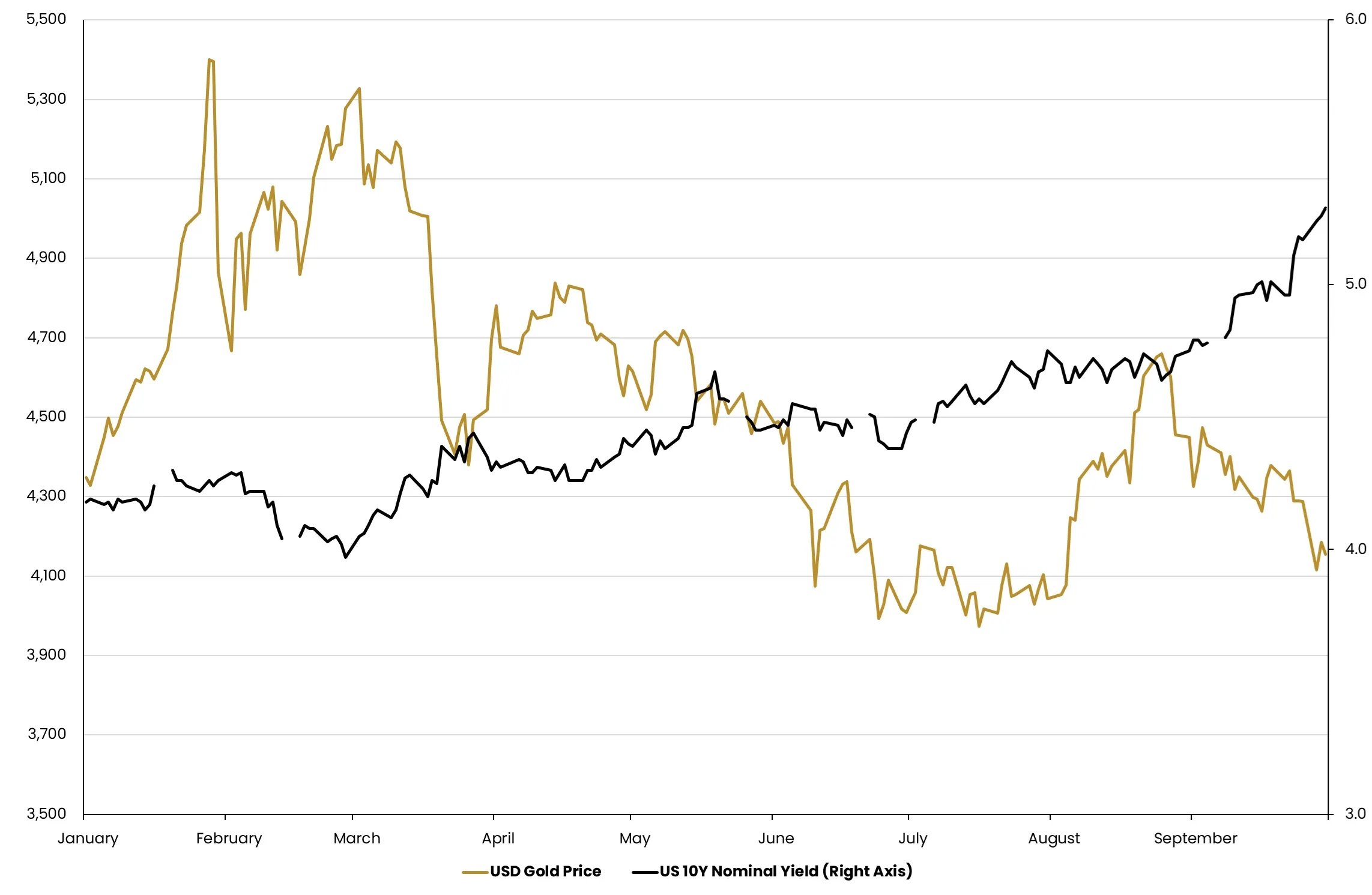
The pullback in precious metals has occurred alongside a sharp rise in global bond yields. US Treasury yields have surged since early 2026, with the benchmark 10-year nominal yield rising by around 120 basis points, currently sitting at 5.29%. Similar moves have unfolded across Australia, Europe, Japan and the United Kingdom, as investors demand greater compensation for holding long-dated government debt amidst persistently high inflation and growing fiscal concerns.
Against this backdrop, precious metals have faced near-term headwinds. However, history suggests these periods are rarely comfortable and often represent some of the most attractive long-term buying opportunities for precious metal investors.
Gold's Current Pullback Remains Well Within Historical Norms
The recent decline has undoubtedly been painful for investors. Gold has now retraced a significant portion of the recovery that took prices close to USD $4,700oz in August this year, with sentiment turning increasingly bearish as the correction has extended.
Yet when viewed through a historical lens, what we are witnessing remains remarkably consistent with prior precious metals bull markets.
As previously highlighted in our prior analysis, major gold bull markets have repeatedly been interrupted by corrections. Since 2003, gold has experienced numerous interim peaks which were followed by periods where prices fell back toward, and often below, their 200-day moving average (DMA).
Importantly, these pullbacks have typically ended only after gold became temporarily oversold relative to its long-term trend.
Historical analysis showed that previous corrections between 2003 and 2022 saw gold trough approximately 10% below its 200-DMA on average. The recent correction has followed a very similar path, with gold once again retreating below its long-term trend (currently 8% below 200-DMA) after becoming significantly overextended during the powerful rally into January (48% above 200-DMA).
The current weakness should therefore not be viewed as evidence that the secular bull market has ended. Rather, it appears more consistent with the type of correction required to reset market positioning, remove speculative excess and establish a stronger foundation for the next advance.
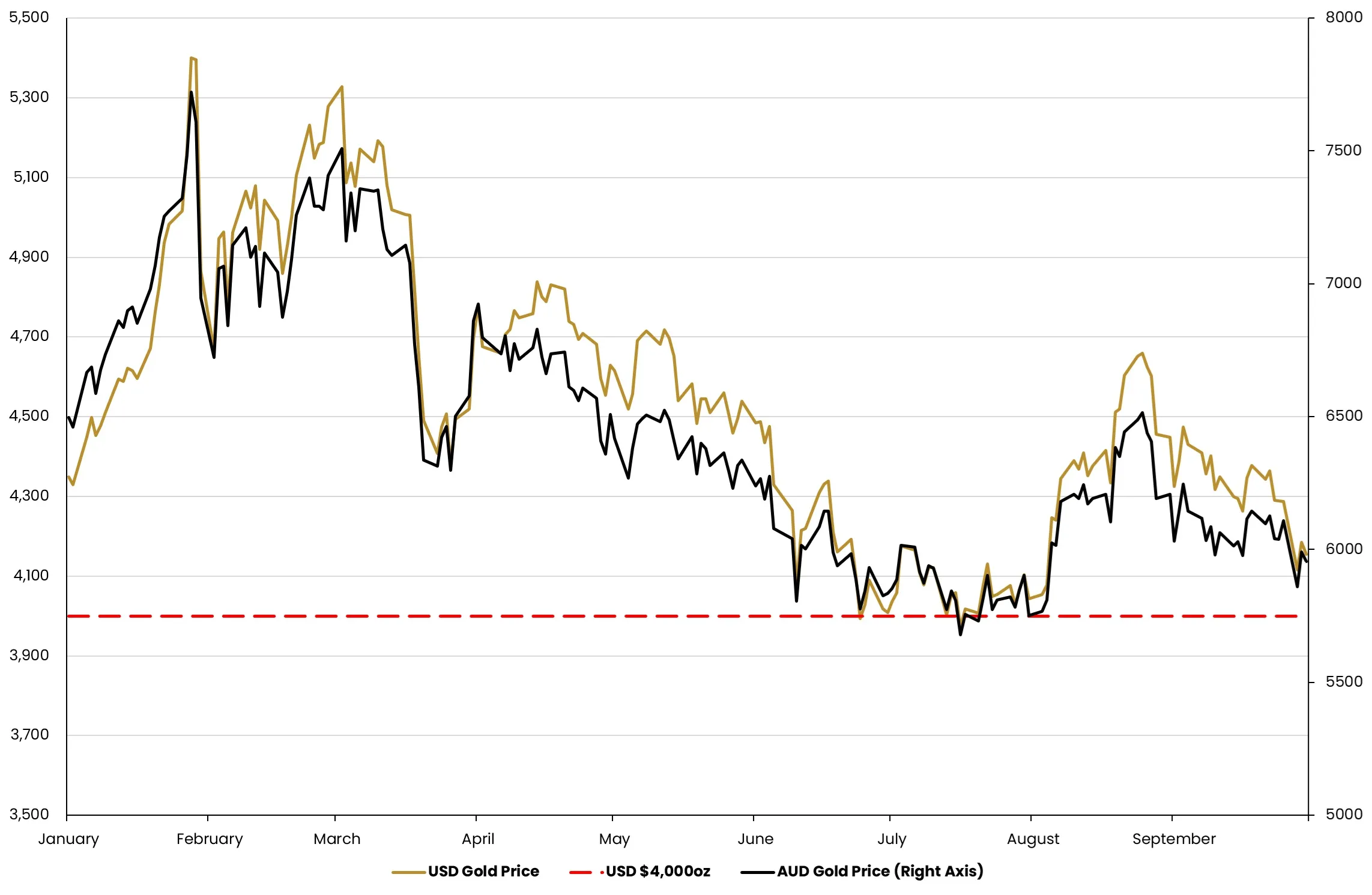
From a technical perspective, a retest of the USD $4,000oz level remains entirely possible (-3.7% from current levels). While such a move would undoubtedly feel uncomfortable in the short term, investors should remember that the USD $4,000oz region has already proven to be a significant support zone throughout 2026.
Gold in USD and Gold in AUD (Jan 2026 – Sep 2026)
Source: LBMA, ABC Bullion
Should prices revisit this level, it would likely represent a further test of investor conviction rather than a fundamental deterioration in gold's long-term outlook.
Rising Yields Are Creating the Headwind
One of the key drivers behind gold's recent weakness has been the sharp rise in sovereign bond yields globally, with the U.S. 10Y nominal yield currently at its highest level since 2007.
Historically, higher yields can act as a headwind for precious metals because they increase the opportunity cost of holding a non-yielding asset. This relationship has been evident throughout recent months, with gold struggling to gain traction as investors rotated back into fixed income markets.
Gold in USD and U.S. 10Y Nominal Yield (Jan 2026 – Sep 2026)
Source: LBMA, FRED, ABC Bullion
The same rising yields creating near-term pressure on gold are also signalling growing concerns surrounding government debt, fiscal sustainability and inflation persistence. Investors are increasingly demanding higher compensation to lend money to governments for extended periods, particularly as debt levels continue to rise across many developed economies (US federal debt to GDP ratio currently at 122%).
In previous cycles, periods of rising yields driven by fiscal concerns have ultimately proven supportive for gold over longer timeframes. While the short-term relationship may appear negative, higher borrowing costs can eventually expose structural weaknesses within financial systems and increase demand for hard assets capable of preserving purchasing power.
Why Australian Investors May Be Better Positioned Than They Realise
While USD gold remains vulnerable to further downside volatility, Australian investors have another important factor working in their favour.
There is an increasing probability that the Australian dollar weakens in the months ahead. The dollar has already fallen from its early September highs of 0.7232 to 0.6977 at present.
The Reserve Bank of Australia resumed tightening as of the 30th of September, raising the cash rate by 25bp in response to persistent inflation pressures (RBA), marking the fourth rise year-to-date and totalling a full 1% increase.
However, a modest undershoot in both headline and trimmed mean Australian inflation data yesterday (August headline inflation rate of 0.4% vs 0.5% consensus) has accelerated the unwind in hawkish RBA pricing, sending the AUD/USDdown towards key support levels.
The implied probability for a 25bp hike at the RBA’s next meeting on November 3 now sits at just 20%, down from 44% last week (Investing.com).
For local precious metals investors, a weaker AUD can provide an important buffer.
Even if USD gold were to retest the USD $4,000oz level, a falling Australian dollar would help support local gold prices, potentially resulting in a smaller move in AUD-denominated bullion.
The Power of Saving in Gold
Periods like the current one also serve as an important reminder that successful precious metals investing is rarely about perfectly timing market tops and bottoms.
Instead, wealth is often built through consistent accumulation over long periods.
Recent RBA rate hikes have once again made cash savings accounts appear attractive, with one-year term deposit rates now around 5% at most of the major banks. While these returns may seem appealing compared to recent years, they remain only modestly above inflation and offer limited long-term purchasing power growth.
Gold tells a very different story.
Since 2000, the Australian dollar gold price has risen from approximately $482oz to more than $5,900oz, generating gains of around 1100% Over the past 25 years, gold has delivered annualised returns of roughly 10%, significantly outperforming both cash savings and inflation.
Even today, despite rising deposit rates, cash investors are earning only marginally positive real returns. Gold, while volatile in the short term, has historically provided a far more effective mechanism for preserving and growing purchasing power over long periods.
This distinction becomes particularly important during corrections such as the one we are currently experiencing. While pullbacks are uncomfortable, they have historically represented some of the best opportunities to accumulate additional ounces before the next phase of the bull market unfolds.
The path higher is rarely linear. Corrections are part of every major bull market. Yet history suggests that investors willing to remain focused on long-term fundamentals rather than short-term volatility are often rewarded.
Until next time,

Jordan Eliseo
General Manager, ABC Bullion

Luke Tyler
Senior Analyst, ABC Bullion
Disclaimer: This document has been prepared by Australian Bullion Company (NSW) Pty Limited (ABN 82 002 858 602) (ABC). The information contained in this document or internet related link (collectively, Document) is of a general nature and is provided for information purposes only.. Although the information and opinions contained in this document are based on sources we believe to be reliable, to the extent permitted by law, ABC and its associated entities do not warrant, represent or guarantee, expressly or impliedly, that the information contained in this document is accurate, complete, reliable or current and accept no liability for any loss or damage relating to any use or reliance on the information in this document. The information is subject to change without notice and we are under no obligation to update it.